2010. április 8., csütörtök

World-class sprinter Overdose hoped to compete again
Hungary's undefeated world-class sprinter Overdose is hoped to recover soon and return to racetracks in the coming months, owner Zoltan Mikoczy told MTI in Berlin on Wednesday.
 
Overdose, who is considered to be the best horse to emerge from Hungary since the great Kincsem in the 1870s, has triumphed in twelve out of twelve races and attracted purchase offers as high as 5 million euros.

    Last April, however, the wonder horse fell ill with laminitis, a chronic inflammation of the hoof. It underwent treatment in France and later in Britain, and the horse is now being rehabilitated in Hoppegarten, the famous racetrack of Berlin.

    Rejoiced at quick progress in recovery, Mikoczy expressed his conviction that Overdose would perform better than before its illness.

    The owner was unwilling to specify an exact date for Overdose's return.

    "Actually we would like to prepare the horse for the Royal Ascot, to be run on June 19," he said. I think this time would be the best race after a long period of time of Overdose. It shouldn't be missed.

    If all goes to plan, it will run at least one preparatory race before that great derby, he added.

    The horse Mikoczy purchased in Britain in 2006 will turn five on April 2.

    The horse is scheduled to return to Hungary in foreseeable time, a condition for it to race in Hungarian colours.

2010. április 7., szerda

An exhibition at Budapest of the
Faces Concealed in Gold - Gold Masks from Asia
The Zelnik Collection at the Museum of Ethnography Budapest

I don't really know how many people have gone crazy about gold. Throughout history, this noble matter has been at the center of interest and has been the subject of greed for centuries. Some lived for it, some died for it. Ladies wore it for beauty, emperors and kings owned it for projecting power. There were men put their lives on finding Eldorado, and alchemist tried to make it. Gold has always meant luxury, extravagance, wealth.


And art has used it. Not surprising, the exhibition called Faces Concealed in Gold – Masks from Asia, opening March 12th at the Museum of Ethnography, will also be centered around the precoius metal.

A world premiere, dr. István Zelnik’s collection is the largest and most exciting collection of golden art works, boasting 24 golden masks hailing from all around the globe; from China to the Java Islands to Southeast Asia and the Balkans covering more than two and a half thousand years of human history. The oldest piece is from the 5th century.

The exhibition explores the ritual significance of these masks as well as their role and power in our lives and afterlives.

2010. március 30., kedd

Budapest from the birds eye

Here is Budapest from the sky in less than 4 minutes.

2010. március 24., szerda


Batthyány Square (Hungarian: Batthyány tér) is a town square in Budapest. It is located on the Buda side of the Danube directly opposite the Hungarian Parliament Building. It is named after Lajos Batthyány, the first Prime Minister of Hungary, and a statue for him was erected in 2008.

Batthyány Square is noted for the Szent Anna-templom (Church of Saint Anne), a Roman Catholic church built between 1740 and 1762, and one of Budapest's most beautiful baroque buildings. The square is also known of its market hall.

The historical Fő utca (Main Street) crosses the square, and connects the lower end of the Budapest Castle Hill Funicular to the Buda end of the Széchenyi Chain Bridge. The French Institute of Budapest is also located nearby.

Batthyány tér is a station of the M2 (East-West) line of the Budapest Metro. The HÉV suburban railway originates from here, connecting Batthyány Square with Szentendre.

2010. március 23., kedd

My favourite place is the Batthyány tér (square) from where you can see Budapest's decisive building the Parliament on the other side of the Danube. It's western face was just finished after 20 years of rerun.
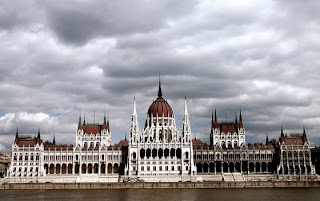
The Hungarian Parliament Building (Hungarian: Országház) is the seat of the National Assembly of Hungary, one of Europe's oldest legislative buildings, a notable landmark of Hungary and a popular tourist destination of Budapest. It lies in Lajos Kossuth Square, on the bank of the Danube, in Budapest. It is currently the largest building in Hungary, and the second largest Parliament in Europe.

Budapest was united from three cities in 1873 and seven years later the National Assembly resolved to establish a new, representative Parliament Building, expressing the sovereignty of the nation. A competition was published, which was won by Imre Steindl, but the plans of the other two competitors were also realized, facing the Parliament: one serves today as the Ethnographical Museum, the other as the Ministry of Agriculture.

Construction from the winning plan was started in 1885 and the building was inaugurated on the 1000th anniversary of the country in 1896, and completed in 1904. (The architect of the building went blind before its completion.)

There were about one thousand people working on its construction in which 40 million bricks, half a million precious stones and 40 kilograms (88 lb) of gold were used. After World War II the diet became single-chambered and the government uses only a small portion of the building today. In the communist regime a red star perched on the top of the dome, that was removed in 1990. Mátyás Szűrös declared the Hungarian Republic from the balcony facing Kossuth Lajos tér on 23d October in 1989.


Similar to the Palace of Westminster, it was built in Gothic Revival style; it has a symmetrical facade and a central dome. It is 268 m (879 ft) long and 123 m (404 ft) wide. Its interior includes 10 courtyards, 13 passenger and freight elevators, 27 gates, 29 staircases and 691 rooms (including more than 200 offices). With its height of 96 m (315 ft), it is one of the two tallest buildings in Budapest, along with Saint Stephen's Basilica. The number 96 refers to the nation's millennium, 1896, and the conquest of the later Kingdom of Hungary in 896.

The main façade faces the River Danube, but the official main entrance is from the square in front of the building. Inside and outside, there are altogether 242 sculptures on the walls.

On the façade, statues of Hungarian rulers, Transylvanian leaders and famous military people are to be seen. Over the windows, there are pictures of coats of arms of kings and dukes. The main entrance is the stairs located on the eastern side, bordered by two lions.

When entering the Parliament, visitors can walk up on great ornamental stairs, see frescoes on the ceiling and pass by the bust of the creator, Imre Steindl, in a wall niche. Other statues include those of Árpád, Stephen the I and John Hunyadi.
There Holy Crown of Hungary is kept in the central hall

One of the famous parts of the building is the hexadecagonal (sixteen-sided) central hall, with huge chambers adjoining it: the Lower House (today the National Assembly meets here) and the Upper House (until 1945). The Holy Crown of Hungary, which is also depicted in the coat of arms of Hungary, has been displayed in the central hall since 2000.

Further features include the stained glass and glass mosaic paintings by Miksa Róth.

Due to its extensive surface and its detailed handiwork, the building is almost always under renovation.

During the Communist regime, the government added a large red star to the central steeple at the dome of the building, but after its downfall, the star was removed from the steeple.

The Parliament is accessible with Line 2 of the Budapest Metro, from the Lajos Kossuth Square station. In front of the building a 1956 Hungarian Revolution memorial is to be found, as well as the imposing Kossuth Memorial and the equestrian statue of Francis II Rákóczi. There is also a sitting statue of Attila József at the side of the Parliament building, as described in his poem By the Danube. Martyrs' Square (Vértanúk tere) is immediately adjacent to Kossuth Square, with a statue of Imre Nagy.

2010. március 20., szombat

Beginning of Budapest

Data
Budapest is the capital of Hungary. As the largest city of Hungary, it serves as the country's principal political, cultural, commercial, industrial, and transportation centre. In 2009, Budapest had 1,712,210 inhabitants, down from a mid-1980s peak of 2.1 million. The Budapest Commuter Area is home to 3,271,110 people. The city covers an area of 525 square kilometres (202.7 sq mi) within the city limits. Budapest became a single city occupying both banks of the river Danube with a unification on 17 November 1873 of right (west)-bank Buda and Óbuda with left (east)-bank Pest.

History
Aquincum, originally a Celtic settlement, was the direct ancestor of Budapest, becoming the Roman capital of Lower Pannonia. Magyars arrived in the territory in the 9th century. Their first settlement was pillaged by the Mongols in 1241-42. The re-established town became one of the centres of Renaissance humanist culture in the 15th century. Following the Battle of Mohács and nearly 150 years of Ottoman rule, development of the region entered a new age of prosperity in the 18th and 19th centuries, and Budapest became a global city after the 1873 unification. It also became the second capital of Austria-Hungary, a great power that dissolved in 1918. Budapest was the focal point of the Hungarian Revolution of 1848, the Hungarian Soviet Republic of 1919, Operation Panzerfaust in 1944, the Battle of Budapest of 1945, and the Revolution of 1956.

Tourist info's
Regarded as one of the most beautiful cities in Europe, its extensive World Heritage Site includes the banks of the Danube, the Buda Castle Quarter, Andrássy Avenue, Heroes' Square and the Millennium Underground Railway, the second oldest in the world and the first underground in Europe. Other highlights include a total of 80 geothermal springs, the world's largest thermal water cave system, second largest synagogue, and third largest Parliament building.

Considered an important hub in Central Europe, the city ranked 3rd (out of 65 cities) on Mastercard's Emerging Markets Index (2008), and ranked as the most livable Central/Eastern European city on EIU's quality of life index (both 2009 & 2010). It is also ranked as "Europe's 7th most idyllic place to live" by Forbes. It attracts over 20 million visitors a year. The headquarters of the European Institute of Innovation and Technology (EIT) and the first foreign office of the CIPA will be in Budapest.
What I read: Moscow blog